Been very carefully nursing a headache for a day and a half, so I go for a long walk to see if it’ll let go. I don’t understand it. This day had such promise, and now it’s a mess on the ground. This city. Why do I only see the current state of items and objects, a snapshot only, instead of the whole picture? Even here, in the in-between, where the past is borne aloft by pigeons, dropped a crumb at a time in the path of my weary feet.
Past the north edge of town, I keep going where the houses and the streetlights don’t. Now I am walking along the Cracked Glass Express: a concrete viaduct, a dry, paved riverbed overhung with low-slung, defeated tree branches. The way is littered with tiny bits of broken glass, green, white, brown. I step very carefully; nevertheless I get a piece stuck in the heel of my right foot, and it hurts.
At the far end of the Express where it is dark and breezy, with dry grasses and matted leaves, I ascend the mystical ladder, right up into the skyway. It is remarkable, and a little disconcerting, how physically close the place is to the ground I have just left.
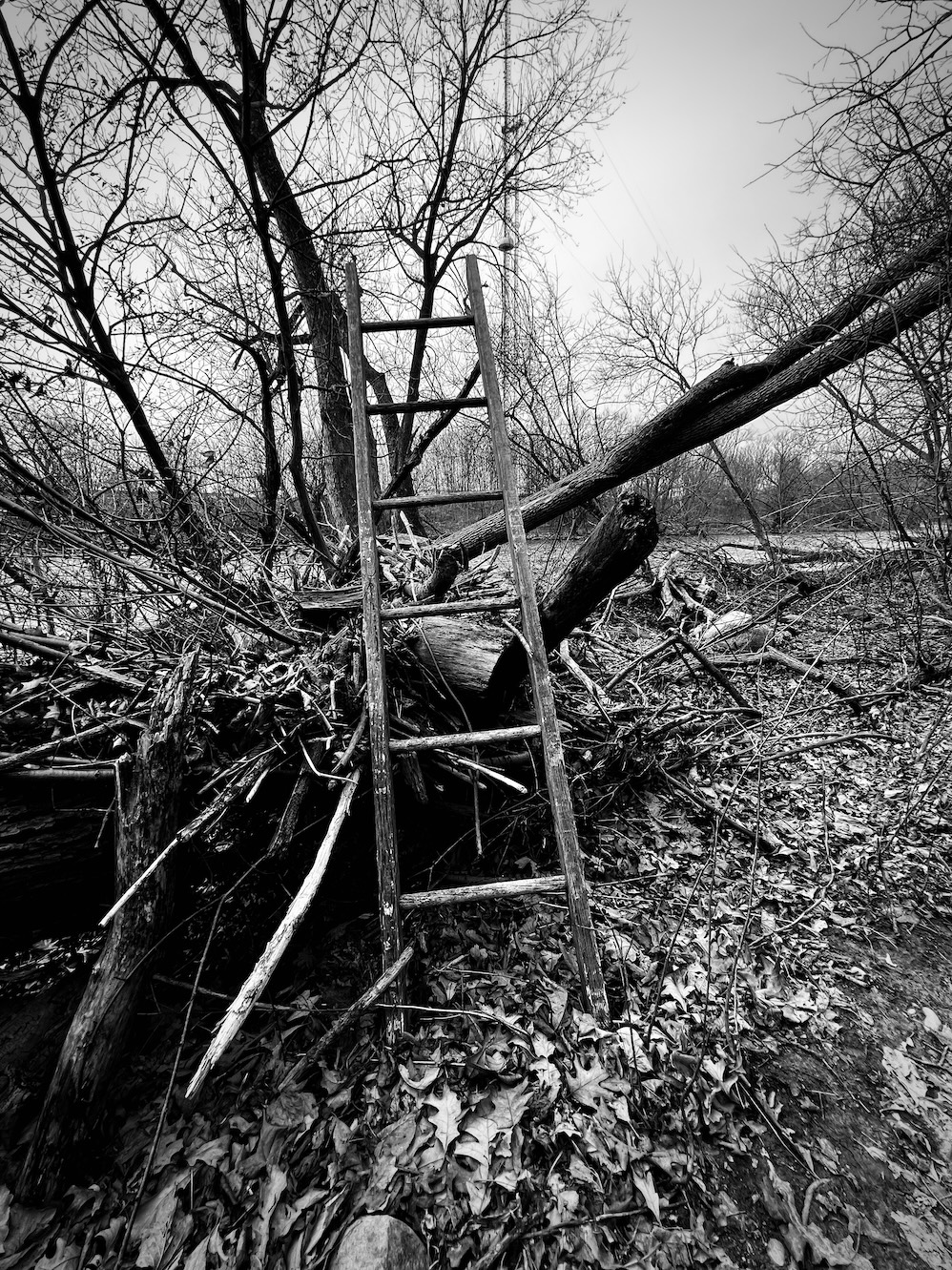
The space into which I emerge is made of dilapidated wood. The floors are half-rotted sheets of paneling and thin plywood whose plies are curling apart. I can feel the haphazardly strewn boards giving way under my weight, even though I am being most cautious, advancing slowly on hands and knees, trying to distribute my impact evenly. It occurs to me that I am risking injury here, and I am not sure why. Is it brave of me, or simply ridiculous to come to this place and play explorer? Do I want to feel adventurous, even if I know deep down the quest is nonessential or even meaningless?
Among the rubble I find a small bit of mattress supported by relatively strong joists, and curl up. My right heel throbs. I doze, feeling in my dream all the hard, sharp, or dirty surfaces around me. This place has all the charm of an antique store, combined with the threatening atmosphere of a mugger’s alley. There is an almost subliminal sense of people nearby in time or space. But I have never seen anyone else in my previous wanderings of the skyway, and I don’t expect to this time.
As soon as I wake, I crawl gingerly across the floor. A couple of times, my knees or hands almost push right through. Eventually, however, I make it to the beginning of a slightly more sturdy stringing together of planks, blocks, boards, and hallways or catwalks, broken only by occasional areas where the path is unclear. I recall that this impromptu causeway stretches along the entire length of the skyway, which is also known as the Highway, or sometimes the Bus. I do not know who named it, nor who originally assembled it, nor who, if anyone, maintains it. Its presence is a common fact of the city, known, eventually, to all who stumble upon it or have some reason to find it.
As I straighten to my feet and stroll, more confidently now, I pass some sights I recognize and some I had forgotten. Some of the shambly, crumbling rooms look familiar. Bits of junk, buckets, trinkets, and scraps of lumber from anybody’s attic adorn the spidery corners in all directions. There is a musty, dusty smell.
Walking on a brace of two-by-fours, I pass a strange and wondrous sight. I decide to call it, in my mental notes to relay to the others, if I ever find them, should they finally make their way to Npydyuan, the strangest thing about the skyway. It is a swimming pool, full of fresh water and young, beautiful life. It is on the other side of a steamy, dripping wall of glass. I can see girls with bathing caps, kids with bellies, moms and dads and lifeguards. It is rich, saturated blue and all the colors of people, a chuckling blue whale improbably thriving in this dead rusty nail sea. I’m sure it wasn’t here before. How does it exist here?
I walk on, thinking about some of the places I have visited farther down the Bus line. I know there are great caverns, places of cool cement and quiet dust, where greenish light filters down as if through endless layers of seawater. There are hulking, silent monsters of stone and metal, who must in some era long ago have performed vital functions, whose tremendous masses must have pounded and swung in the rhythms of major production, of holy purpose, of some technologically inevitable, economically driven reason for being — but nobody knows, now, what exactly they were for, or how they worked, or for whom.
Along a part of the highway that is almost a hallway proper — firm plywood floor underneath, a strong lattice of two-by-fours for walls — I see a very familiar place. It is a double bed, covered with a dusty blue blanket, tucked neatly into a rectangular alcove. I slept here on my first sojourn into the mystical skyway, long ago in another iteration. I remember thinking what a treasure I had stumbled upon; I had felt, I supposed, like Lewis and Clark rounding a twist in the trail to discover a peaceful harbor, a bejewelled waterfall, a pristine valley. I recall having had a pretty good night’s sleep here.
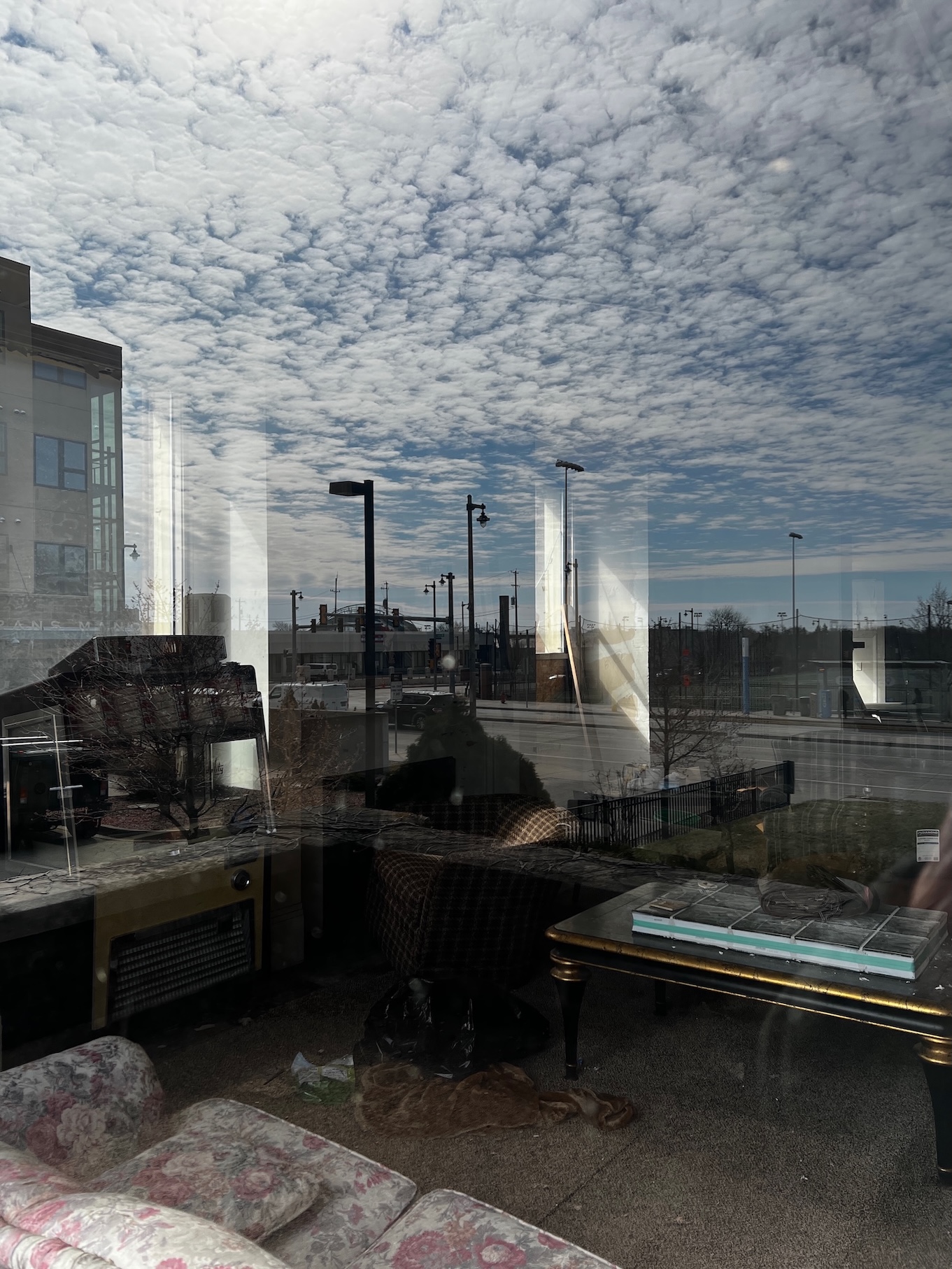
But I am not tired now. Something grips me, and I turn around and head back toward the swimming pool. I step down and to one side of the chaotic construction of this part of the Highway, and find a place to squat and look through the glass enclosure.
Youth and beauty abound here. Kids whose parents have brought them on business trips or vacations. A tightly-knit species of trim-haired people with burgundy cars and clean, white, cross-training shoes. They seem to be functioning according to some unseen clock. Groups of them at this end of the pool, bunches of them at that end; they all seem to know where they belong. I am only ten or twenty feet away from the beautiful, long, wet, stringy hair of one of them. She moves toward me. I get up and go. I do not know what would happen were I to be discovered and thought to be prowling here, but the notion makes me unaccountably uneasy.
Merging back into the meager protection of the Highway, I hear a robust male voice call out, “I’ve seen an interloper! He was lurking at the meeting place of third, fifth and sixth hours!” I quicken my pace slightly. Another voice calls back, “Third, fifth and sixth?” The first voice answers, “Right. Six. Five. Three.”
I think to myself, I’d better not be here when the sixth hour strikes — though I’m not even sure what that means. I move on. Suddenly the half-rotten succession of planks and posts has led me to a place almost outside the skyway altogether. I am only inches above ground level. The sun is wanly shining here, warming some bricks to my right. There is a faint green scent competing with the smells of dust and old cars.
I hop across the gap to a prone tree trunk, regain my balance, and descend. I have exited the skyway nowhere near where I originally entered. The Cracked Glass Express is nowhere in sight. One thing’s for sure: I need to find a place to sit down and get this goddamn piece of glass out of my foot. Every step makes me wince and I’m starting to limp.
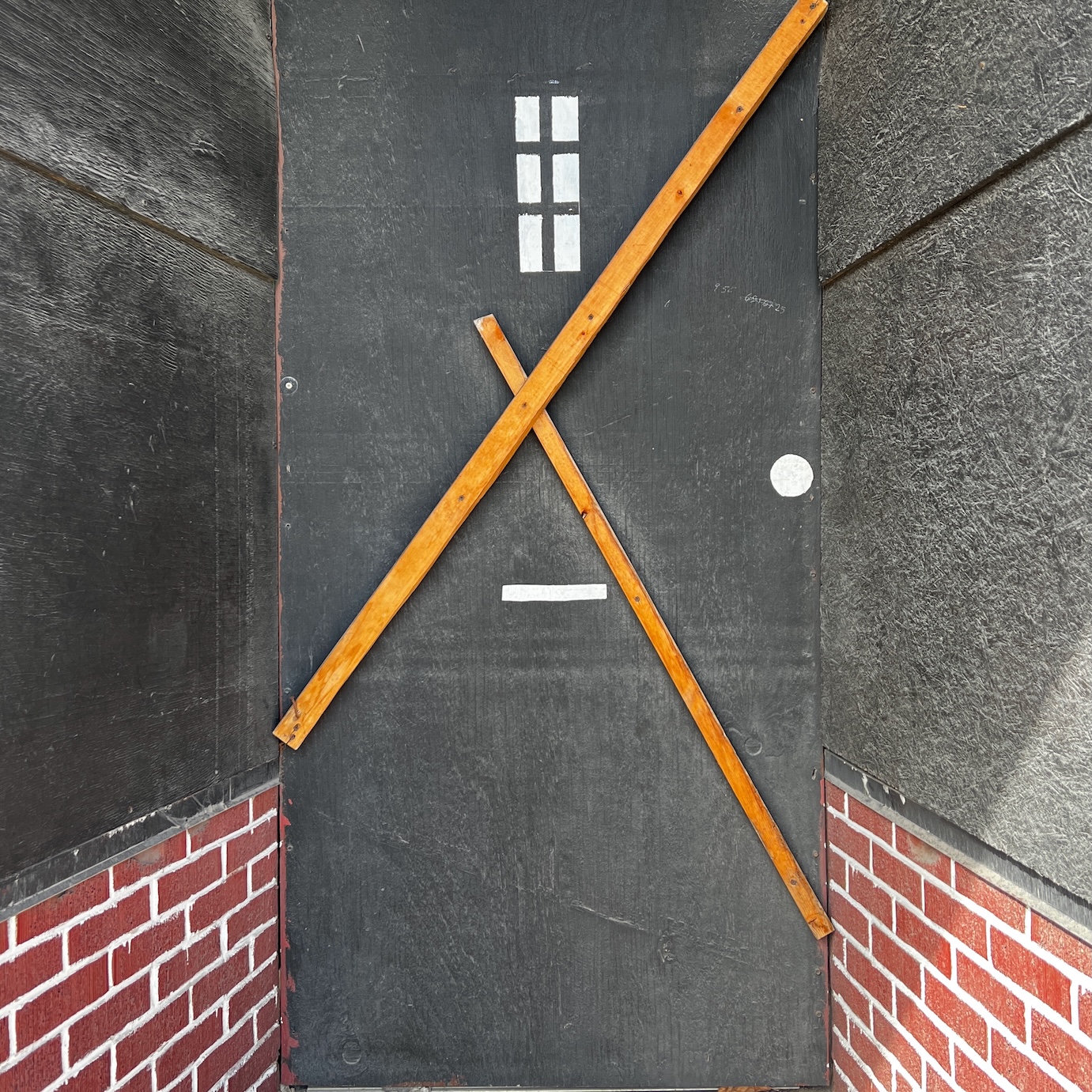
There’s a sidewalk nearby, so I hop onto it. The wind is picking up. Ducking into a boarded-up alcove I see what may or may not be a door. I may or may not find a way to open it, or pass through it, to believe or disbelieve in it long enough to find myself inside the part of the city that, from this vantage point, exists behind it.
I’m at the top of a broadly curved, elegant staircase with a polished wood railing. I follow it down into a room both long and wide, mostly empty. Thin sunlight ambles across the scarred and scuffed wood floor. There’s an old claw-foot bathtub sitting right out in the open. I sit down on the edge of it, lay my right foot across my left knee, and proceed to find the chip of glass in my heel. It hurts like hell to dig it out, but once it’s out I feel like a new person!
Time to explore. A quick jaunt back upstairs reveals a couple of small, square bedrooms, each with its own double hung window with warped glass and ancient counterweights. The woodwork is painted in antique colors, lined with spidery cracks. There’s no furniture to speak of. One larger bedroom looks out on a wide balcony that slopes to one side just alarmingly enough to dissuade me from stepping out to test its sturdiness.
Back on the main floor again — there’s the bathtub, the streaming sunlight (brightening now), a chunky old dining room table with a few mismatched chairs, all at angles slightly askew. There’s a partially open foyer leading to what appears to be a front door, and a small room to one side of that with nothing much in it besides a thin rug, an antiquated electrical outlet, and a radiator that is warm to the touch. Crossing back through the wide main room, I find a spacious (also empty) kitchen, and beyond it the top of a stairway.
This stairway leads down to a coal-mine-looking basement. It smells damp. The light is wan. The bricks of the wall are uneven. There are no exact right angles anywhere. Surely the passage towards the center of the earth begins somewhere in this abandoned cavern. Venturing a few paces into the murk, I see something that catches me by surprise. I can’t believe it at first but as my eyes begin to adapt, it becomes unmistakeable.
There, inscribed on a precarious column illuminated faintly by the glow of a squat old oil-fired boiler — Bnabe’s tag, his name in a stylized flourish. It has to be his, it’s written exactly the way he used to write it. He’s been here. This is it — the first clear sign that at least one of the others is here, in Npydyuan, or has been recently, is possibly even somewhere nearby. I’m not alone.
The sudden infusion of energy this new knowledge gives me sends me caroming back up the narrow stairs, through the kitchen, back into the wide wood room. But just as quickly, I’m exhausted. Suddenly, undeniably, I need to lie down.
The slope of the antique bathtub looks inviting, so I climb in and relax against the cool enamel.
As I make my way towards sleep, this sequence of thoughts flows through my mind with the cadence of a nursery rhyme or fairy tale:
You can only have an adventure with other people.
Other people to share it with,
other people to protect,
to be responsible for,
who will help you when you are in trouble.
Other people to collaborate with,
to celebrate with,
to improvise with,
to report back to,
to give you a reason to keep having adventures.
If you find yourself alone
— start working your way back to Npydyuan.
And ... but ... Bnabe was ... was here!? Here! When — how —
The sussuration of the city shifts to amber, dims by shades until forgotten whispers only reach my dreams.
I dream of headlights advancing through oncoming storms, relentlessly driving uphill with Bnabe and some of the others, the lake to our left, wind, impossibly high waves towering over the city and the tallest trees.
Or maybe that was real, not merely a dream. I resolve to go forth and find out, when tomorrow is today. As it always is, has been, and ever shall be.
An interesting foray into another place/time/reality. You do spin a fine web. I got vibes of a movie that set a record) always felt drawn back to reset and revisit and perhaps because of that, became one of the most memorable "art films" I'd even seen. "Stalker," 1979 is about a guide (Stalker) leading a writer and a scientist through a mysterious, restricted area known as "The Zone" to find a room that grants a person's deepest wishes. He also directed "Solaris," 1972 (the Russian version, not the one with George Clooney that was also pretty good) about a planet with a consciousness. Nice to blur the senses and twist the dials now and again to see what else we can tune into if we're properly aligned to venture into alternative realities, understanding that what happens to us in waking life, or dreams, or ? becomes part of our ever-evolving essence.
Never saw the Solaris movies but read the book several years ago — don't remember much except its fundamental weirdness, heaviness — oddly enjoyable!